|  |
| Main Page |  |
A little about D ring stylesWhile in some ways a D ring is a D ring, but there are differences in contour (shape), thickness, and manufacturing techniques. Here we're going to touch on some of them. Here we will cover: | |
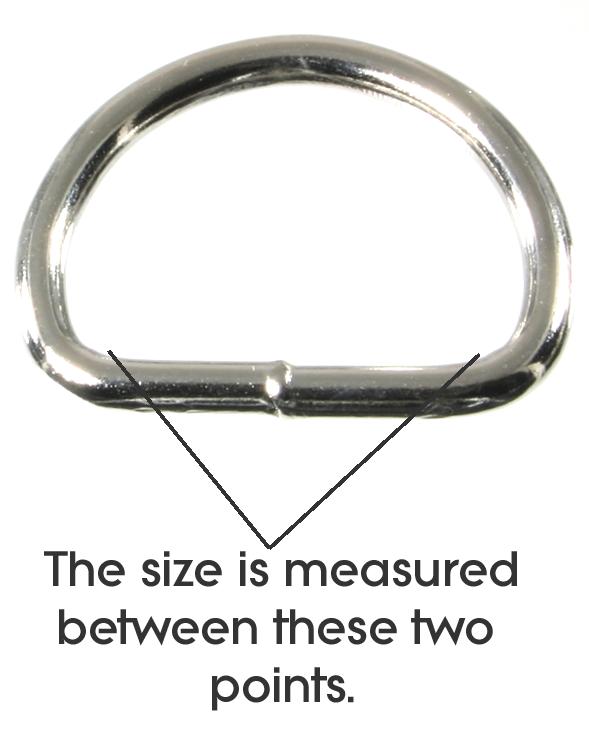
| Click any for a larger image | Measuring D RingsFirst let's talk a bit about measuring D rings - something that many people misunderstand. D rings are measured by their base width. More importantly, you need a D ring that is the same size of the material or leather which you want to put in the D ring. If you have a 1" strap, you need a 1" D ring. |
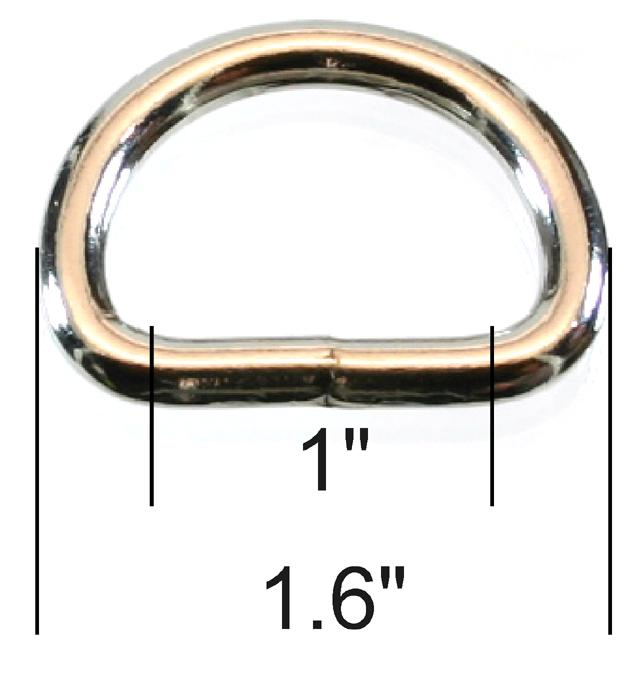 | One of the reasons people get confused when they take a ruler to a D ring and then say it is the wrong size is this: It makes a lot of difference if the D rings is made of heavy or thin material. This, on your left, for example is our heavy welded D ring. It measures 1.6" on the outside. |
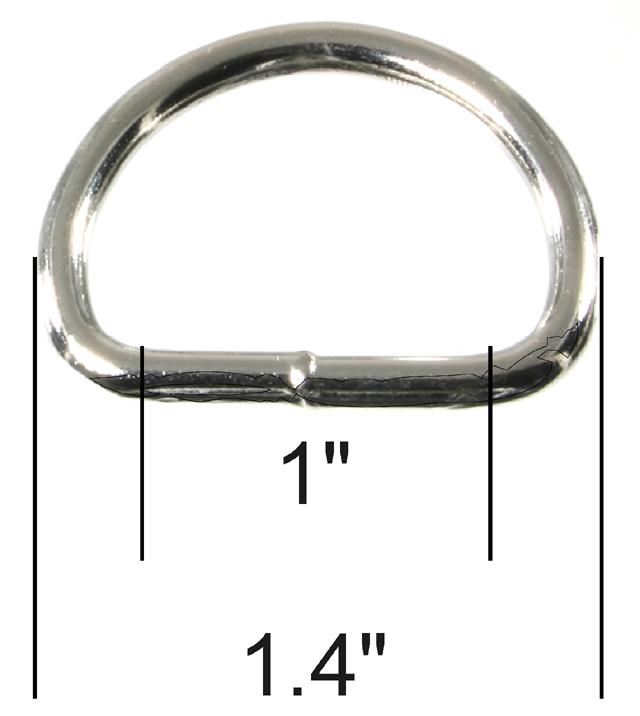 | Now look at this one. It is one of our lightweight welded D rings. It is fully 2/10 of an inch smaller on the outside than the heavy one, yet it is, still, a 1" D ring. So the bottom line is, don't play around with measuring D rings if you are building something, measure your material then just get the same size D. So what if you have the D rings and want to know the correct width to make your material? Here the best bet is to get a caliper. If you don't have one, you can pick up cheap plastic ones (we have them all over the place) for around two bucks. If you only have to do this once, get a ruler or tape measure that starts at 0. I know that sounds funny, but many rulers have a little gap between the printing and the end of the ruler. That's going to be hard to use. In either case, caliper or ruler, you want to measure the flat section of the D. Notice in our images, the lines measuring the size of the D ring are not at the very edge of the base. You measure only the flat section. All wireformed D rings (made by bending wire into the correct shape) almost always have a curve at the bottom, and you don't want to be measuring that curve. Usually only cast D rings are squared off at the bottom - more on that a little further down. |
Wire Formed D RingsNon welded wire-formed D rings.Yup, there's no picture here. We don't sell them. Our business is leather making hardware, and while our supplies can be used for many different materials, we want all of our supplies to be suitable for leather craft. Non-welded D rings will come apart under heavy stress. If you're making dog collars and half your customers have their dog run loose because your D ring opened up, well, that's not exactly good for business. There is a place in this world for non-welded D rings, and they can be just the slightest bit less expensive. They just won't cut it for leather work. | |
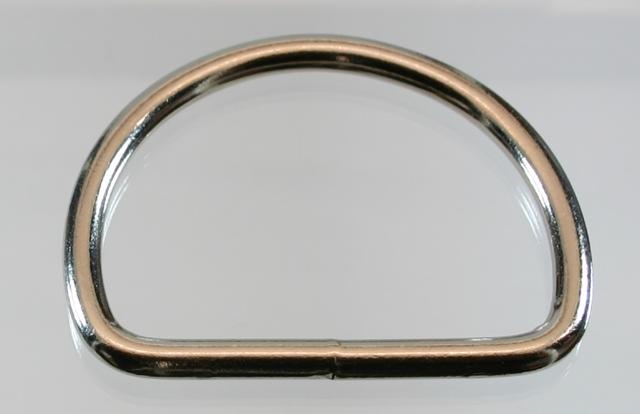 Light Weight Nickel 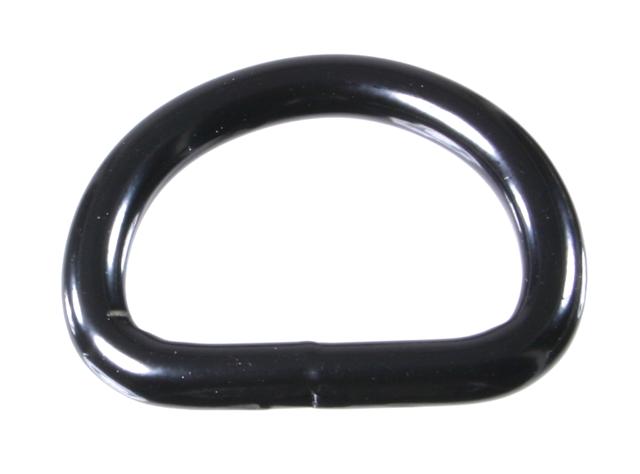 Heavy Black 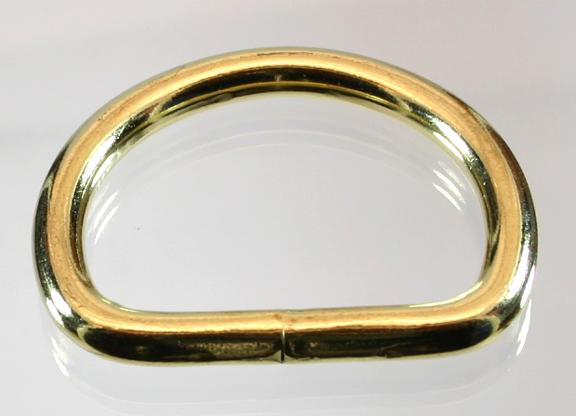 Heavy Brass Plated 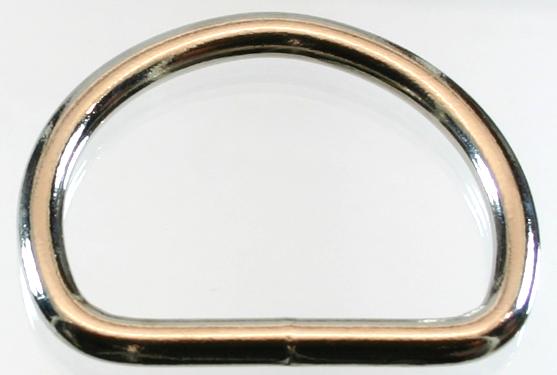 Heavy Weight Nickel | Welded wire-formed D ringsWe all probably know what a D ring looks like, but do you know how they are made? First the manufacturer decides on the size of the wire they want to use. Two things come into consideration here. First is how heavy-duty they want the D ring to be. Not just "how tough do I want this to be", but also how bulky do I want this to be. A big heavy duty D ring looks good on horse tack, heavy dog collars, big backpacks. It would, however, look silly on a dog collar for a chihuahua! Secondly is "can I bend this wire to make the D ring?" The same wire thickness used to make our 3" D rings could never be bent into shape for a 1/2" D ring. Once that decision is made they set about creating the machine parts that will be used to cut and form the D ring. It is really cool to watch these machines fly through making rings. It first cuts the proper length of wire, then one arm pushes it into a curve (into one of the dies made by the manufacturer), then two more arms bend the rest into a flat bottom, a welding rig moves in, welds the seam at the bottom, and then the ring drops into a bin below - all of this in about two seconds. The next step is finishing. The D rings are given a bath in chemicals, dried, and then, depending on the finish desired, dipped in plating solution, powder coated, or chemically blackened. You can read a little about finishes if you are interested on our Explaining Finish Types page. All welded D rings have a seam at the bottom where the weld was applied. A decent ring will have just a small bump, no misaligned wire, no sharp edges. This weld is going to be covered by your material, leaving only a nice clean seamless D ring visible. Pictured alongside is a sample of some of our welded D rings. We offer a variety of shapes, and a selection of finishes. They are the work-horse of D rings for leathercraft. Find them on dog collars, as we mentioned, as well as harnesses, tote bags, camera straps, backpacks, tool belts (as a point for hanging tools), cloth or leather belts (in a pair for friction closure), and plenty more. |
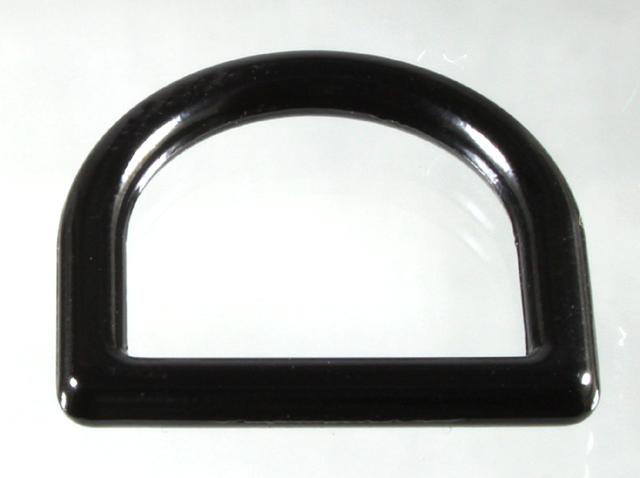 Cast Black 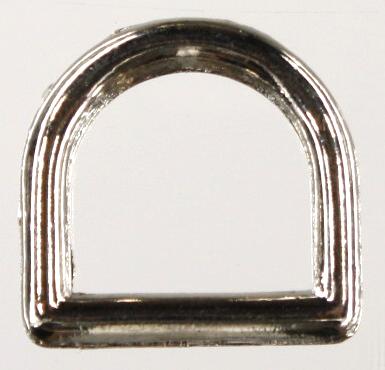 Cast Nickel Plated | Die Cast D Rings
A completely different manufacturing process in use for these die cast rings. They are made by pouring molten metal into a mold, and when they harden and cool off then they are treated to a finishing process, just like the others above. These can be made of just about any metal you can imagine. In practice there is usually only two commonly found. The most common is zinc. Zinc takes a finish beautifully, melts at the relatively low temperature of around 425 degrees, and is inexpensive, as far as metals go. The second most common is solid brass. While you can purchase brass plated zinc hardware, for some situations a solid brass product is a better choice for the maker. There is a drawback however. Brass is expensive! The raw brass is about 1 1/2 times as expensive as zinc, and it melts at around 950 degrees. That means much higher cost of raw materials, and much higher cost of energy to produce. Doesn't make it fall in the "not worth the money" category - not at all. It is all a matter of the needs of the craftsperson. The other thing about die cast D rings is that they can be made in any contour one desires. We spoke about how all wire formed D rings are curved at the bottom. That is not necessarily the case with die cast D rings. If the desired shape is a square shoulder (like the examples to your left) then all one has to do is make the mold with a square bottom. As the manufacturing process for wire formed is less expensive than with cast, you will normally only find cast D rings in smaller sizes. Tiny wire formed rings are hard to make, while you could make a really tiny cast D ring if you desired. So the cast small D rings look nicer, usually, than wire formed. Also, because casting a great big D ring would be quite expensive, you'll usually only find wire formed large D rings. Die cast rings are the perfect choice for small pet collars, keychains, camera wrist straps, small purses, ID tags and much more. |
Other informational pages we hope you will find helpful: Explain the different D rings styles (this page) | |